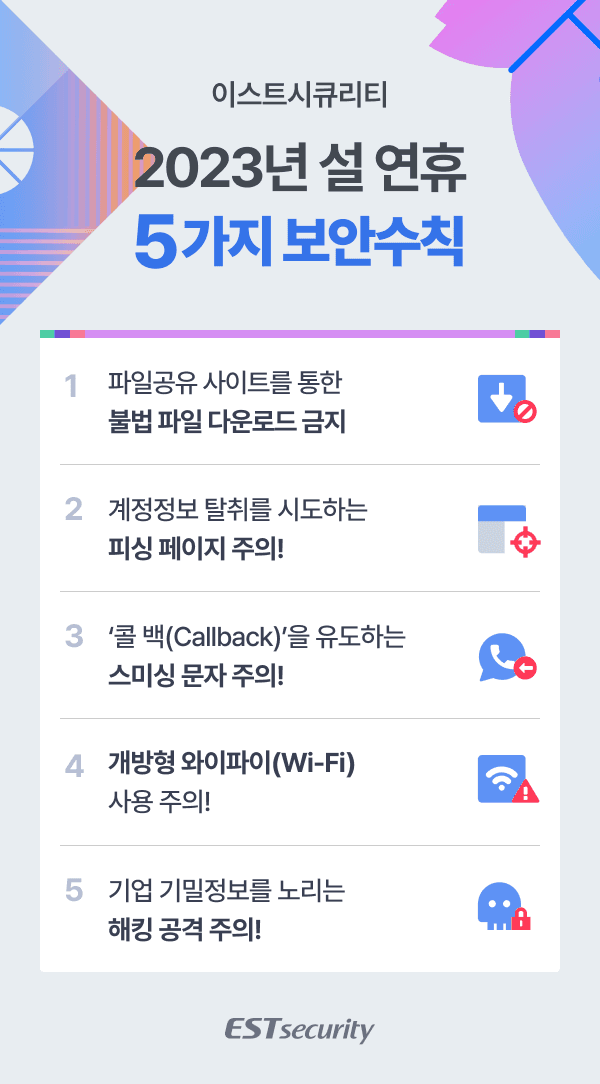
ESTsecurity (CEO Jung Jin-il), a security specialist, released five information security rules on the 18th that users should follow to keep the Lunar New Year holiday safe.
▲ Do not download illegal files from file sharing sites
With influenza and COVID circulating at the same time, many people are expected to spend the holiday watching films and dramas rather than travelling to their hometowns.
Files distributed through file sharing programs are highly likely to contain malware, while free video streaming sites carry numerous advertisements placed for revenue whose servers can download malware automatically — so particular care is needed.
Always use official channels to download content or watch video, and delete immediately any file that downloads automatically while browsing. It is also advisable to install a trustworthy antivirus product such as 'ALYac' to keep your PC safe.
▲ Beware of phishing pages that try to steal account credentials
Phishing attacks that try to steal account credentials are expected to increase over the holiday, when people spend more time online.
Credential theft attacks are attempted mainly through phishing emails containing links to phishing pages; attacks that display a portal login pop-up when a user visits a legitimate page have also been detected frequently of late.
If credentials are leaked, further harm can follow through secondary and tertiary attacks using them, so particular care is needed.
Check the sender's address when you receive an email, and always check the URL of the page you visit. Setting up two-factor authentication strengthens your account security further and prepares you for the worst.
▲ Beware of smishing messages designed to prompt a 'callback'
With gifts exchanged widely during the holiday, smishing messages about shopping mall and overseas purchase payments are expected to increase.
Smishing that includes a phone number such as a customer center, rather than a malicious link in the SMS, to prompt users to call back is on the rise. Calling the number leads to identity verification and then to installing a malicious app that attempts to steal personal and financial information; the same pattern has recently been seen in messages about opening bank accounts or issuing certificates, so particular care is needed.
If you receive a suspicious SMS, delete it immediately rather than calling back, and install a mobile antivirus product such as 'ALYac M' to keep your mobile device safe.
▲ Take care with open Wi-Fi
With more people travelling during the holiday, take care not to leak information over open Wi-Fi.
Open Wi-Fi has the advantage of reducing personal data use, but carries a range of risks: a malicious user may spoof a legitimate SSID to lure users in, or manipulate DNS to redirect them to a phishing page.
Users are advised to minimize their use of open Wi-Fi and, where it is unavoidable, to avoid financial transactions and services requiring a login, and to use cellular data when checking sensitive material.
▲ Beware of hacking attacks targeting corporate confidential information
Take care against hacking attacks targeting companies' confidential information.
Attacks targeting companies occur frequently during holidays and weekends, when most corporate security staff are away.
Corporate security staff should check internal infrastructure and employee PCs and patch vulnerabilities before the holiday. They should also back up important data and update emergency contact lists so they can respond promptly if an attack occurs.
ESTsecurity, working with the Korea Internet & Security Agency (KISA), is running intensive monitoring to prepare for email and smishing attacks using holiday-related keywords, and is preparing for cybersecurity incidents. It urged particular care ahead of the holiday, since attacks during that period are difficult to address promptly with staff away.