ESTsecurity (CEO Jung Jin-il), an integrated security company, warned on the 8th that North Korea-linked hacking attacks disguised as cloud sharing invitations from a Korean portal company have recently been detected one after another, urging particular care.
The attacks were found to be phishing campaigns aimed mainly at experts and journalists working on North Korea, cunningly impersonating a real service with many Korean users.
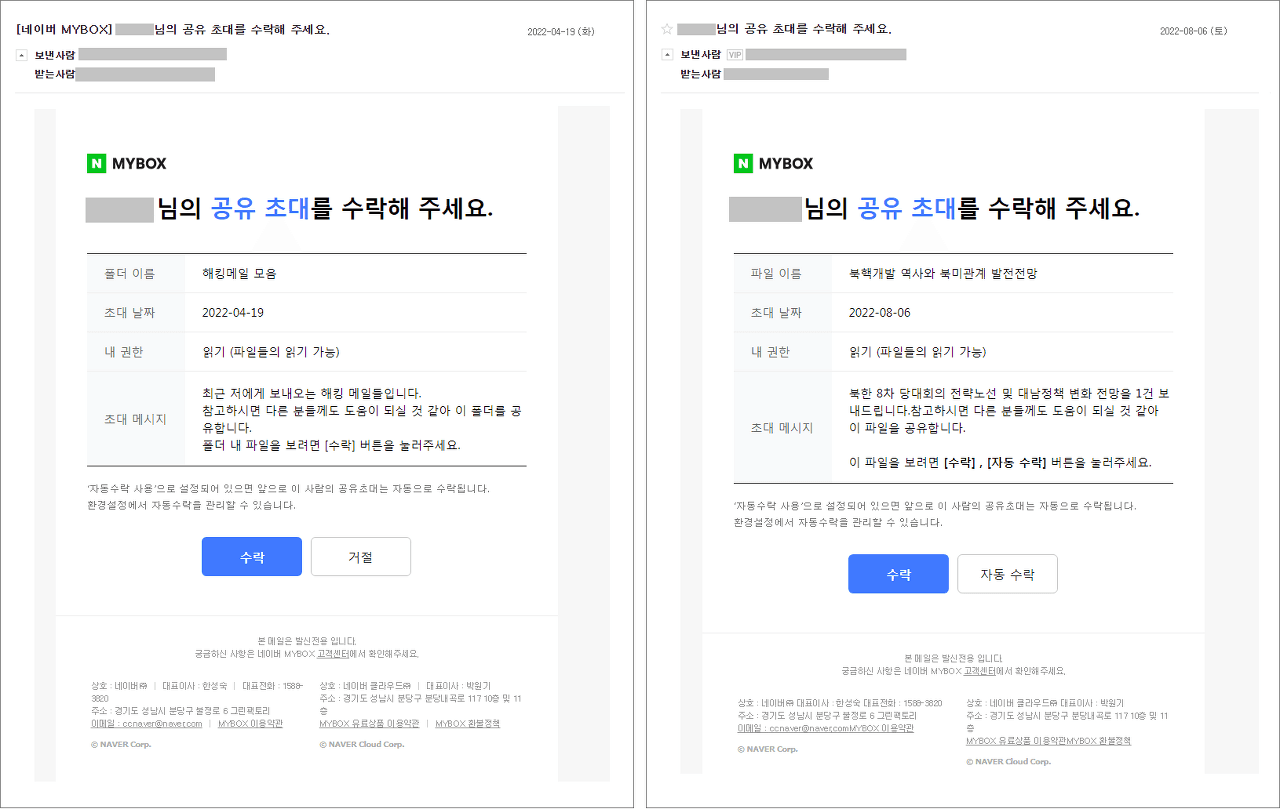
The attack carried out last Saturday lured recipients as though a file titled 'The history of North Korea's nuclear development and prospects for US-DPRK relations' had been shared with them, and was characterized by the cloud sharing invitation being sent under the stolen name of a figure who served as first deputy director for overseas and North Korean affairs at the National Intelligence Service under a previous administration.
To induce a click on the accept button, the body of the hacking email even included an invitation message reading, "I am sending you one item on the strategic line of North Korea's 8th Party Congress and the outlook for changes in its policy toward the South. I am sharing this file as I think it may be helpful to others as well if you take a look" — content manipulated to make the recipient trust it further.
Analysis by ESTsecurity's Security Response Center (ESRC) revealed that clicking the [Accept] button for the sharing invitation in the body of the hacking email connects to phishing servers such as 'share.myboxes.navers[.]tech' and 'view.boxfile[.]click', which attempt to steal the user's password.
The attacker did not actually use the portal cloud service's sharing invitation feature, but the body of the hacking email imitates the genuine service's design and wording so closely that a recipient who has previously received such a share is highly likely to be exposed to the threat without particular suspicion.
ESRC, which has been analyzing this attack technique for several months, said this attack too is an extension of the "Summits NFT reward impersonation hack" of last July, believed to be aimed at earning foreign currency, and of the "hacking attacks disguised as the issuance of health checkup result certificates" found continuously since the first half of the year. It explained that after comprehensively analyzing the key indicators of compromise (IoC) and the threat strategy, the attack was finally attributed to a hacking group linked to North Korea's Reconnaissance General Bureau, classified as "KGH".
The cybersecurity threat group identified as being behind this attack was also found to have taken part in an attack last July that impersonated an identity verification notification email from a smart credit service provided by a particular Korean credit card company and a financial information protection service.
That attack was a phishing campaign that impersonated a service notifying users by SMS and email when identity verification occurs in a financial service under the customer's name, luring them to click a [Check identity verification history] button and connecting them to the phishing server 'hanacard.navceo[.]website' to attempt to steal the recipient's email password.
Attackers are thus using a variety of themes to attack figures in Korea's North Korea field persistently until a hack succeeds, and they are actively employing not only URL phishing that simply induces a click but also attacks using malicious DOC and HWP documents.
An ESTsecurity ESRC representative said: "With the Korea-US joint exercises beginning on the 22nd, the cyber offensive attributed to North Korea is growing ever fiercer," urging care and adding, "This is a time when individuals and companies alike must raise their interest in and alertness to cybersecurity, eliminate security blind spots and complacency, and take every precaution — so as not to be exposed in particular to everyday-style email hacking attacks disguised as the sort of content people encounter around them all the time."
ESTsecurity is working closely with the Korea Internet & Security Agency (KISA) and other relevant authorities on measures to prevent the spread of similar harm.