ESTsecurity (CEO Jung Jin-il), a security specialist, said on the 22nd that a North Korea-linked hacking attack disguised as a notice of non-fungible token (NFT) compensation for past SUMMITZ coin victims has been found in Korea, and that particular care is required.
The SUMMITZ coin fraud was a case around 2018 in which a coin issue was passed off as backed by the technology of a major Korean conglomerate, drawing in numerous investors in a scam. At the time, people were deceived into increasing their investments as though the conglomerate's owning family had also taken part, but it emerged that this was entirely groundless — with no conglomerate technology involved and no agreement signed — leaving investors to bear the losses in full.
The SUMMITZ co-CEO at the time is reported to have been sentenced to prison for violating the Act on the Aggravated Punishment of Specific Economic Crimes and to be serving that sentence.
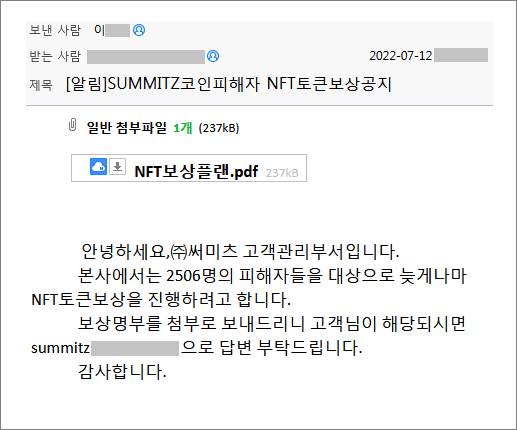
The newly discovered attack targets people who took part in SUMMITZ-related investment in the past, those curious about NFT compensation, and bitcoin holders. The attacker sent an email titled '[Notice] NFT token compensation notice for SUMMITZ coin victims', disguised as an NFT compensation notice being carried out at head-office level by SUMMITZ's customer management department for 2,506 victims.
According to the email, the attached file 'NFT compensation plan.pdf' contains the compensation list and recipients are urged to check whether they are on it and reply — but an investigation by ESTsecurity's Security Response Center (ESRC) confirmed that it connects to a malicious phishing site.
If the recipient clicks the attachment area, a password entry site (private-banking-group[.]com) disguised as a portal service's identity verification service appears, and entering information there leads to personal information being leaked without the user's knowledge.
The internet site's address and its actual internal web pages contain NFT- and bitcoin-related content, so it can look like a legitimate site at a glance, but it is currently being abused for hacking purposes, so access should be restricted and blocked.
In investigating the case, ESRC detected the attacker's use of the domains 'sslnaver[.]online' and 'cdndaum[.]online', and identified a history of the address 'lion.simba21@protonmail[.]com' in those domains' registration information.
It also confirmed that beyond the NFT compensation guise, the attacker used the same 'private-banking-group[.]com' address multiple times in attacks impersonating portal customer centers aimed at people working on North Korea.
These actors have for years posed as portal companies' customer centers to mount persistent hacking attacks on North Korean defectors and people working in diplomacy, security and unification. Notable domains they used for phishing include 'navers[.]online', 'navers[.]store', 'naveos[.]online', 'naveos[.]website', 'com-silver[.]site', 'com-pass[.]online', 'com-password[.]link', 'com-info[.]store', 'com-checking[.]link', 'confirm-pw[.]link', 'com-share[.]bar', 'nonghyup[.]website', 'com-gstatic[.]link' and 'jiia[.]tokyo', and the email 'fullget888@gmail[.]com' was used in the registration details of some addresses. These addresses were detected in cyber threat cases attributed to North Korea.
ESRC Director Moon Jong-hyun said: "This attack was analyzed as part of the North Korea-linked campaign known as KGH, along with February's attack on a Korean terrestrial broadcaster and the impersonation of the Japan Institute of International Affairs, and March's attack disguised as the issuance of health checkup certificates," adding, "Attacks targeting North Korean human rights experts and professors in diplomacy, security and defense are intensifying amid inter-Korean political issues such as the recent repatriation of North Korean fishermen," and urging stronger cybersecurity practice as a matter of national security.
ESTsecurity's ESRC, meanwhile, is closely sharing related cyber threat information with the Korea Internet & Security Agency (KISA) and other relevant authorities, maintaining cooperation to prevent known threats from spreading.