You can also find this content on ESTsoft’s official LinkedIn and Facebook.
ESTsoft is an AI agentic company that makes everyday life easier with technology anyone can use. We create AI services that add agents to the tools and services people use every day, making AI accessible to everyone.
The world is full of stories, and new content is being created all the time. While channels make it easy to encounter stories from around the globe, great content often fails to cross borders simply because of language barriers. No matter how compelling a story is, its meaning can be hard to convey to people who speak another language. So good stories don’t stop at language barriers, ESTsoft’s global AI dubbing SaaS, "Perso Dubbing ", expands a single piece of content into 99+ languages through dubbing technology.
In this installment of Itself, we meet the team that goes beyond building an AI dubbing service to help it grow, making Perso Dubbing discoverable and accessible to users around the world. the Perso Dubbing Studio We spoke with the team. Our interviewee is Bae Untae, who leads global growth on the Growth team in the Perso Dubbing Studio. He shared how Perso Dubbing is reaching users around the world, how the team incorporates rapidly evolving AI technology, and what they consider as they engage with users across different countries.
Q. Hello. To start, could you introduce yourself and briefly tell us what you do at the Perso Dubbing Studio?
Hello, I’m Bae Untae from the Growth team at the Perso Dubbing Studio. Externally, I use the title Head of Growth.
I’ve worked as a product owner (PO) for over 15 years. Now I help people around the world discover Perso Dubbing, try it for themselves, and become paying users when they need it.
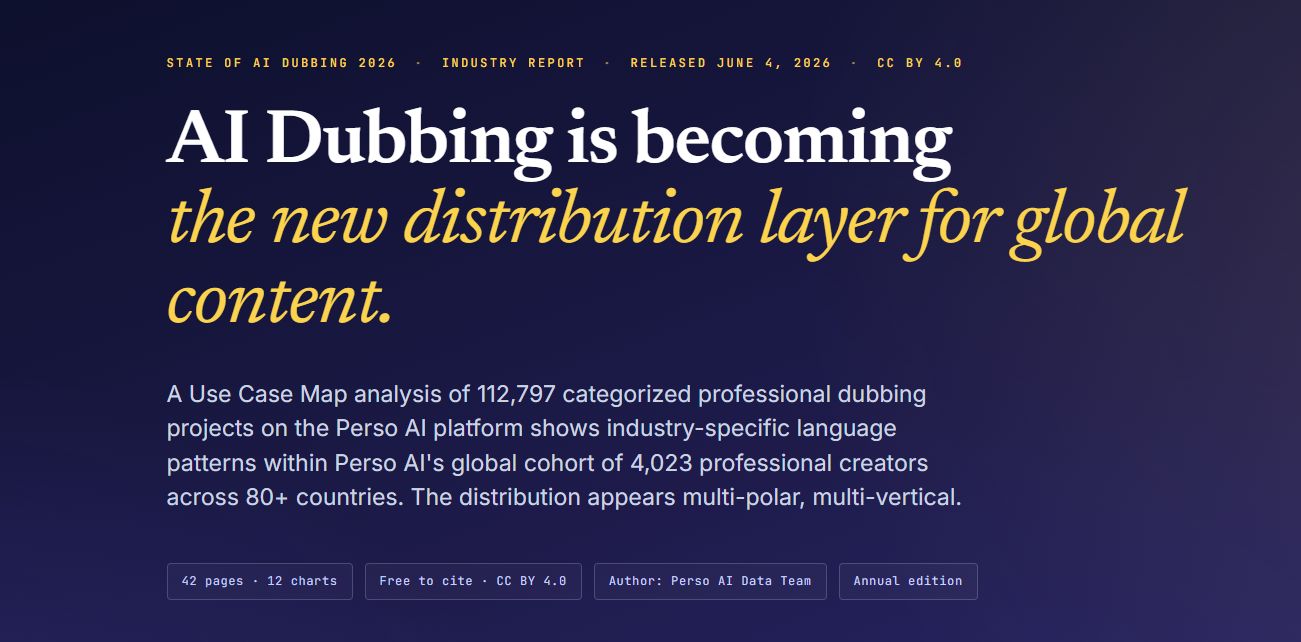
My role covers a pretty broad range of work. These days, my main focus is the Perso Dubbing desktop app and turning it into a free app with unlimited dubbing, so more people can install and use it. I also work to make Perso Dubbing more visible in Google Search and AI search tools like ChatGPT; handle advertising and data analysis; create thought leadership content such as blog articles and industry reports; respond to inquiries from overseas companies; set pricing policies; and prepare to launch new dubbing models. It’s a busy time.
Q. What is Perso Dubbing? Who needs it most?
Perso Dubbing is a service that uses AI to dub videos into other languages. You upload a video to the web and select one of 99+ languages. The service dubs it while preserving the original speaker’s voice, tone, and manner of speaking. Once you upload a video, it first separates the voice from the background audio, then transcribes the speech (STT), translates it into your chosen language, and turns it back into speech (TTS). We focus on preserving the original speaker’s voice, tone, and manner of speaking throughout. Paid plans also include lip sync to match the dubbed audio to the speaker’s lip movements. Perso Dubbing is a global SaaS focused on overseas markets. Our data reflects its global reach. This year, about 90% of new subscribers from August to October were outside Korea. Brazil and the United States have the most paid subscribers. Korea is also a major market. Here, many instructors and universities use it to offer courses in multiple languages; companies use it to show overseas customers how to use their products; religious organizations such as churches use it; and YouTubers use it to grow their international subscriber base.
Q. These days, automatic translation and dubbing are easy to find on familiar platforms like YouTube and Instagram. What do you think sets Perso Dubbing apart?
To start with the numbers, the web service supports dubbing in 99+ languages. As of October 2026, total sign-ups had exceeded 600,000, and subscribers were spread across more than 150 countries. From January 2025 through August 2026, more than 380,000 projects were created in Perso Dubbing. On G2, a global software review site, we have a rating of 4.3 out of 5 (as of November 2026). What I’m most proud of is how easy it is to use. G2 reviewers mention this a lot, too. You don’t need to know how to edit or record; just upload a video and choose a language. You can use it right on the web, or use the desktop app for PC. We also offer several features to make dubbing easier. You can add the original SRT subtitle file when dubbing, and upload a glossary to register technical terms or abbreviations in advance and apply them to the translation. For example, “ESTsoft” might be pronounced as “Esteusopeuteu” in Korean, so you can teach the system in advance to say “Isteusopeuteu.” Similarly, even if people in Korea commonly shorten “KakaoTalk” to “Katalk,” you can have it translated and dubbed as “KakaoTalk.”
Once dubbing is complete, you can review the final text. Check the text transcribed through STT, correct any errors, and redo the dubbing. You can also use that text to easily dub the video into another language.
Q. What does Perso Dubbing do especially well, and what values matter most as you build the service? Please also tell us what you focus on to improve dubbing quality.
What we’re confident in, of course, is dubbing quality. Creating good dubbing takes more steps than you might expect. As mentioned, when you upload a video to the web service, we separate the voice from the background audio, transcribe the speech (STT), translate it, and turn the translated text back into speech (TTS).
It’s essential to preserve the original voice naturally. If the voice suddenly changes or the translation sounds awkward, viewers quickly lose their immersion and leave the video. We put care into every step, from audio separation to STT, translation, and TTS, so the original voice is preserved and the translated language sounds natural.
Thanks to our ongoing quality improvements, top YouTubers in Korea and overseas also use Perso Dubbing. We take great care to make sure each creator’s distinctive voice and personality come across naturally in other languages.
We also use both our own dubbing models and foundation models from global AI companies. We adopt good technology quickly while continuing to build our own models and data. Since each dubbing model has different strengths and characteristics, users can try the models for themselves and choose which one to use. For example, Nightingale may work better for videos that depend on emotional performance, while another model may be better for clear delivery in lectures or narration. To help users choose, we’ve published evaluations on our website showing what each model does well. We’re also competitive on cost. With the economical Finch model on the PRO plan, dubbing currently costs about $0.11 per minute. We’re continuing to develop models that cost even less. We’re also preparing a desktop app for unlimited dubbing with free models on macOS and Windows, so anyone can try AI dubbing without worrying about the cost. Our goal is to let people start with a free model and choose a paid model when they need higher quality.
Q. You’re building Perso Dubbing while keeping pace with rapidly changing AI technology. What is the most challenging part of the work, or what do you find yourself thinking about constantly?
As you said, the technology changes incredibly fast. New models come out every few months, and each time we have to try and compare them before deciding whether to add them to our product. And an answer that was right yesterday might be wrong today, so I can never stop learning (laughs).
Working with users in more than 150 countries also brings challenges beyond the product itself. Payment methods vary by country, European companies request invoices that include VAT, and inquiries pile up overnight because of time zone differences.
Another ongoing question is when people actually need Perso Dubbing. The novelty of “my video speaks another language” alone doesn’t keep people using it for long. They keep using it when there’s a clear purpose, such as helping students overseas understand a lecture or helping local customers understand a product explanation. That’s why, in our marketing, we try to start with who uses it and for what, rather than simply describing features.
Q. There are challenges and concerns, but what do you find rewarding about building Perso Dubbing?
Every day, I hear about different needs from customers in different countries. We get inquiries from all kinds of organizations, including education companies in South America, sports apps in Europe, and media companies in Southeast Asia. From my desk in Korea, I get to learn how markets around the world use dubbed videos.
Also, because we’re an AI product team, we get to try new AI tools at work before others do. We try new things right away, and if something works well, we may even change the way we work.
Perso Dubbing helps anyone easily adapt videos into other languages as a global AI dubbing SaaS. Even as AI technology advances and the global market continues to change, the service keeps expanding its growth. The Perso Dubbing Studio responds by trying new technologies firsthand and quickly incorporating them into its work and processes whenever they see value for the product.
In the next installment, we’ll take a closer look inside the Perso Dubbing Studio and hear how the team turns insights from users around the world into product and service growth, while quickly applying new AI technology to their work.